
Pennsylvania State University
Nanofabrication Lab
Penn State University, University Park, PA
Expertise: Materials and chemical technologies at the molecular scale with unique strengths that include surface chemistry, self-assembly, and the fabrication and processing of complex oxide materials.
The Penn State Nanofab provides users with 24/7 open-access to facilities that enable fabrication of a wide range of devices and characterization to support fundamental and applied research in diverse fields spanning electronics to medicine.
Academic and industry users can perform research on-site using facility equipment, training, and staff support. The technical staff can also provide “remote services” in which they do your research for you.
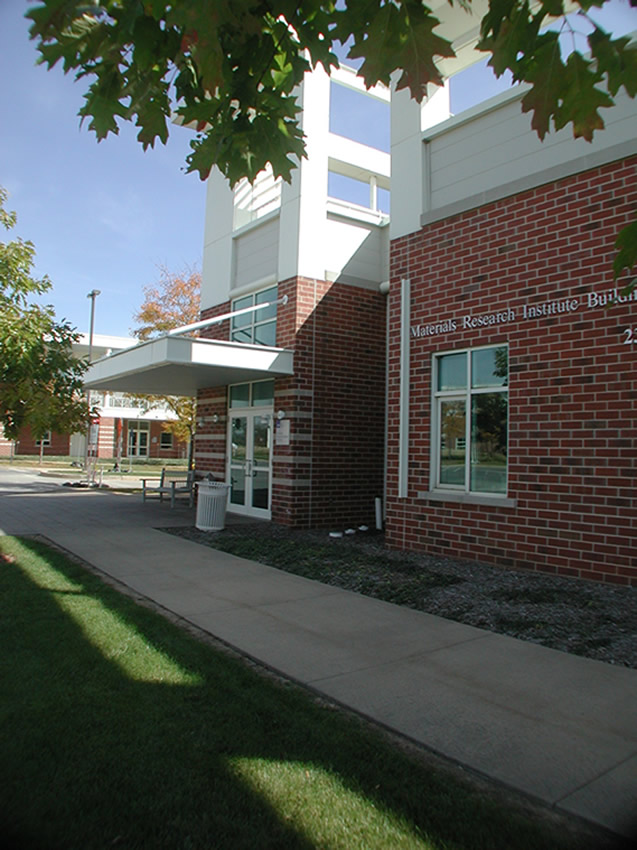
The Penn State facilities consist of approximately 6000 square feet of clean room space and over 3000 square feet of supporting non-clean lab space that is located at our Materials Research Institute (MRI), Materials Research Laboratory (MRL), and Electrical Engineering West (EEW) Buildings. The largest laboratory in MRI contains clean process bays and adjoining semi-clean cluster areas that support all aspects of deposition and etching, micro- and nanolithography, and process metrology equipment. The second Keck Smart Materials Laboratory cleanroom in MRL contains several instruments specialized for complex ferroelectric oxide materials processing, which includes oxide thin film deposition (e.g., PZT, PLZT, SrTiO3, BaTiO3, etc.) and metal contact sputter deposition. The third lab in EEW contains additional process bays that support specialized MEMS processing systems for silicon and ferroelectric oxide device fabrication, which include new deep silicon and oxide reactive ion etch (RIE) tools and a XeF2 silicon release etch tool.
The Penn State Nanofab is part of the Materials Research Institute’s shared user facilities which also includes the Materials Characterization Lab (MCL). MCL is a fully staffed analytical laboratory that offers researchers convenient and affordable access to a wide range of state-of-the-art 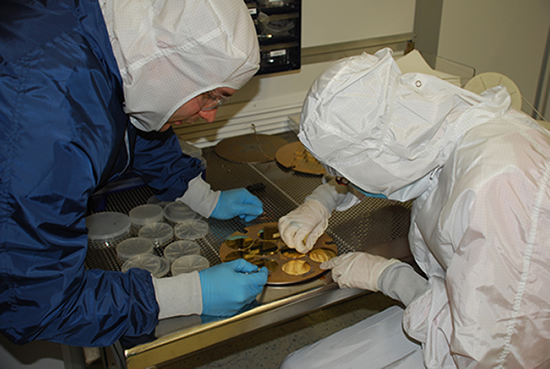 analytical instrumentation which complements the Nanofab tool sets.
For more information contact:
Jaime Reish
Administrative Coordinator
(814) 865-7348
Email
or visit the website at:
www.mri.psu.edu/facilities/NNIN